

A session for Classes 8–10
The Story of
Thinking Machines
From room-sized calculators in 1950 to machines that paint, write and dream, in 2 hours.
Press the right arrow key, or click anywhere, to begin →
1950s
The first giant thinkers
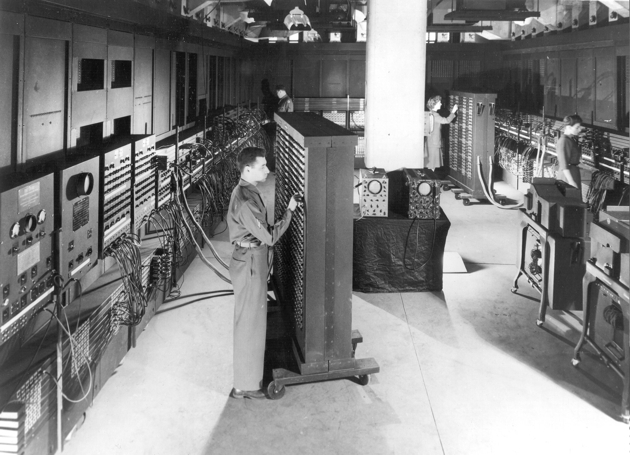
The earliest computers filled entire rooms, ran hot with glowing glass tubes, and were "programmed" by physically rewiring cables or feeding in stacks of punched cardboard cards. Take ENIAC, built in 1945 in the US: it weighed as much as three elephants, filled a 50-foot room, and used 18,000 glass tubes, yet it could still do less math than the phone in your pocket.
1950s – 2000s
Teaching machines to listen
Flipping switches by hand didn't scale, so humans invented languages a computer could follow. Here's the exact same instruction, print "Hello, World!", written in four different eras. Watch what happens to the effort.
Machine code
10110000 01001000
10110100 01000001
11001101 00100001
Assembly
MOV AL, 'H'
MOV AH, 09h
INT 21h
C
#include <stdio.h>
int main() {
  printf("Hello!");
}
Python
print("Hello!")
Same result. From days of wiring, to one line a beginner can write on day one.
1970s – 1990s
Computers start counting
As businesses stored more records, computers were put to work summarizing them: totals, averages, trends by month. This was "analytics": turning piles of raw numbers into something a human could actually understand, usually by the next morning's report.
✓ Report ready
1990s – 2000s
Data that never sleeps
Waiting until morning stopped being good enough. Sensors, bank transactions and website clicks began streaming in every second, so computers learned to analyze data the instant it arrived, flagging a fraud attempt or a server crash in milliseconds instead of overnight.
LIVE transaction feed
2000s – 2010s
Guessing what happens next
Once computers could see patterns in the past, the next step was obvious: use those patterns to predict the future. Will this customer cancel their subscription? Will it rain tomorrow? Predictive analytics turned history into a forecast.
Customer logins, last 6 weeks
0% chance this customer cancels next month
2010s
Learning from examples
Instead of a programmer writing exact rules for every situation, machine learning flips the job around: show the computer thousands of examples (emails marked spam, photos labelled "cat") and let it work out the pattern itself. The more examples, the better its guesses get.
Training examples
Model accuracy: 0%
2012 – 2018
Teaching machines to see
Pictures are just grids of numbers to a computer: millions of tiny brightness values. Computer vision is the skill of turning that grid into understanding: this pixel pattern is a face, that one is a stop sign, this one is your dog. It's the same skill your phone uses to unlock when it sees your face.
✓ 0 objects detected in 0ms
Pause the story
Let's go live
Presenter: open ChatGPT, Claude or Gemini in a browser right now and ask it something the class suggests. Then come back for the rest of the Generative AI story.
2022 – now
The computer becomes an artist
Every machine so far analyzed, sorted or predicted things that already existed. Generative AI does something new: it creates things that never existed before (a paragraph, a picture, a song) by learning the patterns of millions of examples and remixing them into something fresh, one word or pixel at a time.
“|”
✨ Generated, not copied
Today
Meet the AI assistants
Different companies have built their own version of a text-and-idea generator. They feel like typing a question into a very well-read friend. Watch three of them answer the exact same question.
“|”
ChatGPT
Built by OpenAI
|
Claude
Built by Anthropic
|
Gemini
Built by Google
|
Watch it think
What "generating" text looks like
It isn't looking this up. It's predicting the next word, then the next, based on patterns from everything it read during training.
Today
"Draw me a..." and it does
The same remixing trick works on pixels, not just words. Describe a scene ("a tiger made of stained glass, sunset light") and an image model paints it from scratch. Video models now do the same thing across time, frame after frame.
Already in your pocket
You've been using this all along
Instagram & Snapchat filters
Computer vision finds your face in real time, 30+ times a second, then generative tricks warp it into puppy ears, a glow, or a whole new face.
Snapchat AI lenses
Some lenses don't just overlay stickers: they generate a new background or style around you on the fly.
Your "For You" feed
TikTok, Reels and YouTube Shorts use predictive analytics: ranking millions of videos by how likely YOU are to watch the next one.
Photo "enhance"
That one-tap photo fix that removes blur or boosts a dark photo is a generative model repainting pixels it thinks should be there.
Siri & Google Assistant
Voice becomes text (recognition), text becomes an answer (generation), and the answer becomes speech again, three AI steps in under a second.
Auto captions & translate
Live captions on a reel, or a caption auto-translated into another language, are both generative language models at work.
Try it yourself
Be your own filter app
This is the same idea behind an Instagram filter, just the "see" half, running live in your browser. Turn on your camera and try a style.
Click "Turn on camera" to start
So far
Generative AI in one line
It's not a calculator anymore. It's an artist, a writer, and a conversation partner, trained on patterns, not programmed with rules.
Not yet reached
AGI: a mind for any task
Every AI you've seen today is a specialist: brilliant at one kind of job, lost outside it. Artificial General Intelligence is the idea of a machine that can learn and reason across any task a human can (cooking, coding, comforting a friend) without being rebuilt for each one. No one has built this yet.
Each one is brilliant at its own job, and useless at the others.
A question, not an answer
ASI: beyond our own minds
Artificial Superintelligence describes a hypothetical machine that doesn't just match human thinking, but surpasses the best human minds at everything: science, strategy, creativity. It's a thought experiment scientists debate carefully, not a product on a roadmap. The honest answer about when, or if, is: nobody knows yet.
If we scaled "problem-solving ability"…
From 1950 to right now
You just lived through
75 years of AI history
Questions are the next step. What would you build?